
As babies start to explore and put things into their mouths, it is important to be aware of potential choking hazards in their environment. Any item smaller than a 20-cent coin can pose a choking hazard for a baby.
Food is a common cause of choking for babies and toddlers as they have small airways and their reflexes are not yet fully developed. Be aware of choking hazards as you start to introduce solids to your baby.
Safety steps to prevent choking:
Around the home:
- Keep items smaller than a 20-cent coin out of sight and reach of your baby.
- Keep items containing button batteries and magnets out of reach.
- Check for loose polystyrene beads in bean bags that can be inhaled.
- Buy toys that are suitable for your child’s age by following the labels. Toys taht can break easily and have parts that come loose should be avoided.
- Keep older children’s toys away from young children. This means separate play areas for children of different ages.
- Check all toys regularly for wear and broken parts which could come loose.
Feeding your baby:
- Ensure your baby is sitting down when they are eating and always supervise them.
- Avoid giving hard food to your baby. Food such as raw carrots, celery sticks and apples can be grate, par-boiled or mashed to reduce the risk of choking.
- Do not give popcorn, nuts, whole grapes, hard lollies, corn chips or other similar foods to your baby.
- If your baby is distressed or upset, do not force them to eat as this may increase their risk of choking.
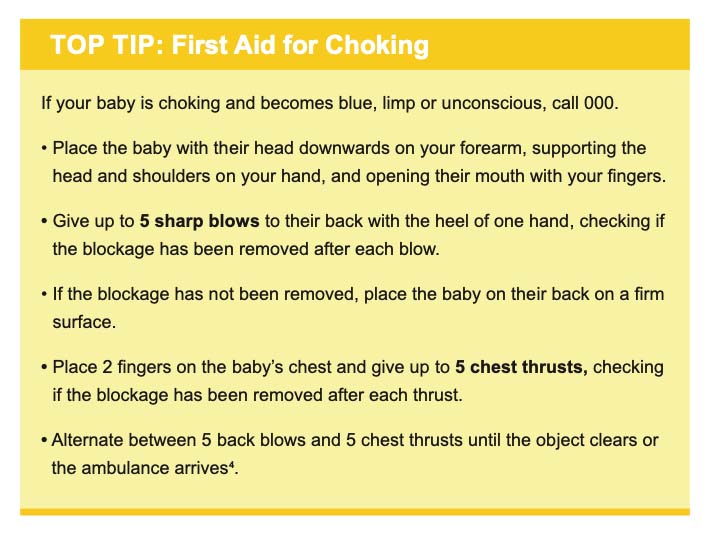
If your baby is choking and becomes blue, limp or unconscious, call 000.
- Place the baby with their head downwards on your forearm, supporting the head and shoulders on your hand, and opening their mouth with your fingers.
- Give up to 5 sharp blows to their back with the heel of one hand, checking if the blockage has been removed after each blow.
- If the blockage has not been removed, place the baby on their back on a firm surface.
- Place 2 fingers on the baby’s chest and give up to 5 chest thrusts, checking if the blockage has been removed after each thrust.
- Alternate between 5 back blows and 5 chest thrusts until the object clears, or the ambulance arrives.
Suffocation
Suffocation can happen to a baby when their supply of oxygen is blocked, which can be caused by an item blocking their airway or covering their mouth and nose.
There are many household items that can pose a potential suffocation hazard for babies. These items can include:
- Plastic bags
- Cling wrap
- Pillows
- Bean bags
- Balloons
- Bedding
- Soft Mattresses
Safety steps to prevent suffocation:
Plastics:
- Always store plastic bags, plastic wrap and dry-cleaning bags out of reach of your baby. Tie a knot in them before storing or throwing them away.
- Always remove plastic covers on cots and bassinet mattresses before use.
- Always keep balloons (particularly uninflated ones) out of reach of your baby. Loose plastic from popped balloons may block your baby’s airway if inhaled.
Sleeping:
- Always remove accessories such as bibs and headbands before putting your baby down to sleep.
- Don’t use pillows or bumper pads in your baby’s cot, as these can be a suffocation risk. These are unnecessary items for babies under two years of age.
- Choose a firm mattress for your baby’s cot. Using soft mattresses, bean bags and water beds can increase your baby’s risk of suffocation.